

- Home
- Configurator
- Documentation
- Map
- List
- Statistics
- Packets
MeshCore 868 MHz
Technical Study: 868 MHz Band
This study was prepared by a group of volunteers who chose to remain anonymous. Their time, resources and research were essential—especially during the three weeks after the announcement of a switch to narrow-band settings in 868 MHz, when efforts intensified. We thank everyone who contributed.Updated 14/10/2025
Why change is necessary
The 868 MHz band — specifically 869.400–869.650 MHz — is highly contested because it permits higher transmit powers (up to 500 mW vs. 25 mW or 10 mW). As a result, many services operate in this portion of the spectrum, including Meshtastic and, more recently, MeshCore.The central frequency 869.525 MHz is used by LoRaWAN (SF9, BW125), which occupies much of the band’s centre. Transmitting in that segment—now heavily used nationwide—should be avoided.Initially MeshCore used parameters identical to Meshtastic (250 kHz BW), which effectively occupied the available spectrum. In addition, other higher-power services (for example LoRaWAN) also share this band and increase congestion.MeshCore originally used SF10 while Meshtastic used SF11; that difference reduced some collisions but did not solve the problem. In the UK, parameters were later changed to SF11 (a 3 dB advantage), which caused full collisions with Meshtastic. That change did not affect Portugal, where SF10 remained in use.
Motivation for change
Portugal’s growing MeshCore deployment requires a careful selection of LoRa parameters. The congested band motivates choosing a cleaner slot to avoid interference and to protect existing services. The network’s growth must not harm other users of the unlicensed band. Measures promoted elsewhere (e.g. narrow-band proposals in the UK) are not necessarily suitable for Portugal's technical and operational context.

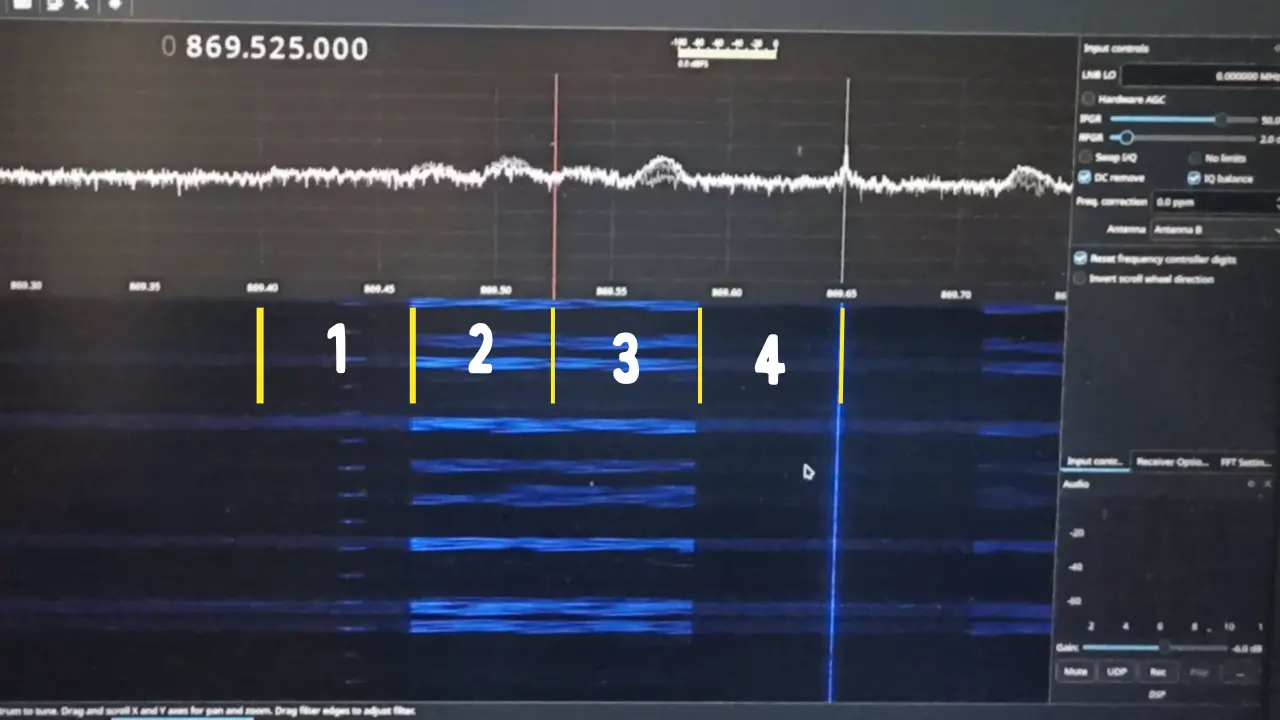
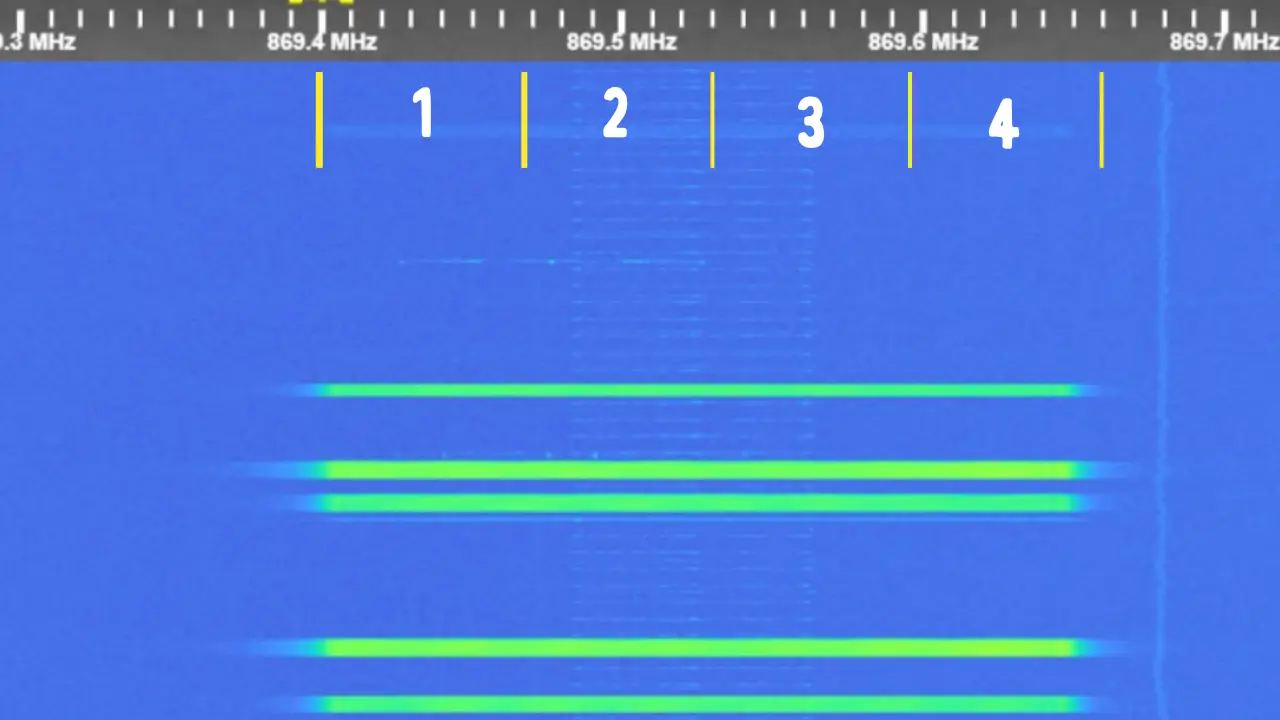
International profile analysis
We review several international channel profiles, examining frequency, bandwidth (BW), spreading factor (SF) and coding rate (CR) to identify practical options and pitfalls for Portugal.
EU/UK (Narrow)
869.618 MHz BW62.5 SF8 CR8
Narrow-band (slot 4) improves resistance to noise and interference.
Reduces interference with many coexisting services.
Achieves only ~977 bps, slightly above our 433 MHz profile (~732 bps).
Using CR=8 is questionable because it consumes significant capacity for error correction.
Czech Republic (Narrow)
869.525 MHz BW62.5 SF7 CR5
SF7 with CR5 yields higher bitrates (~2.73 kbps).
The frequency choice overlaps the band centre and conflicts with existing emissions (e.g. LoRaWAN), making it unsuitable in Portugal.
Neither profile perfectly fits Portugal’s needs. Given mesh deployments are typically local, Portugal can select parameters best suited to its reality while taking cross‑border interoperability into account.
Recommended solution for Portugal
Keep the MeshCore 433 MHz profile unchanged (433.375 MHz, BW 62.5 kHz, SF9, CR6). For 868 MHz, adopt a narrow-band approach (62.5 kHz) and parameters that prioritise coexistence and throughput. Gateways that bridge 433 and 868 networks will help extend coverage by allowing users to connect through either band.
Design criteria
Target throughput > 2 kbps
Minimise collisions with existing services
Prefer narrow-band (62.5 kHz) to improve coexistence
We combined field measurements across representative locations with a spectrum occupancy survey to identify free channels and verify existing services. Growth projections and traffic modelling estimated future throughput requirements.
A theoretical review gathered case studies and technical reports on LoRa modulation (SF/BW/CR). Industry and academic experts were consulted to validate assumptions and provide practical guidance.
Configuration options were benchmarked against established EU/UK and Czech channel profiles to assess interoperability, regulatory constraints and operational implications. The result is a phased transition plan with risk mitigation measures.
Frequency
869,61875 MHz
BW
62,5 kHz
SF
7
CR
4:6
Estimating network saturation
This section describes how to estimate the maximum traffic a LoRa network can carry before reaching saturation. We analyse airtime — the transmission time of each packet — using different configuration profiles and observed average message sizes.These are theoretical estimates obtained under ideal conditions; real-world performance is affected by obstacles, interference and device distribution. Use the results as a comparative guide rather than an absolute capacity figure.
Bitrate calculation

Bitrate measures how many bits can be transmitted per second. The table shows bitrate calculations for each LoRa profile.
| Profile | BW | SF | CR | Bitrate |
|---|---|---|---|---|
| PT-433 | 62.5 | 9 | 4:6 | 732.4 |
| PT-868 | 62.5 | 7 | 4:6 | 2278.6 |
| UK-868 | 250.0 | 11 | 4:5 | 1074.2 |
| UK-868-Narrow | 62.5 | 8 | 4:8 | 976.6 |
The coding rate is expressed as a ratio: 4/5, 4/6, 4/7 or 4/8.

Calculating airtime is more involved: first compute symbol duration (seconds), then the number of preamble symbols and payload symbols, and finally combine them to get total airtime.

Compute symbol duration:

Compute number of preamble symbols:

Compute payload symbol count:

| Freq | Preamble | Payload | Tsb | Spre | Spay | Ttotal |
|---|---|---|---|---|---|---|
| PT-433 | 16 | 68 | 8.192 | 20.250 | 100.000 | 985.088 |
| PT-868 | 16 | 68 | 2.048 | 20.250 | 128.000 | 303.616 |
| UK-868 | 16 | 68 | 8.192 | 20.250 | 69.818 | 737.839 |
| UK-868-Narrow | 16 | 68 | 4.096 | 20.250 | 147.000 | 685.056 |
From 3700 observed packets, average packet size is ~86 bytes. Assuming a 10% duty cycle (6 minutes per hour), airtime can estimate saturation points for each profile. The proposed PT-868 profile increases capacity by about 3.2× (320%) compared to the current 433 MHz profile at certain operating points.